Love and Lies by Clancy Martin
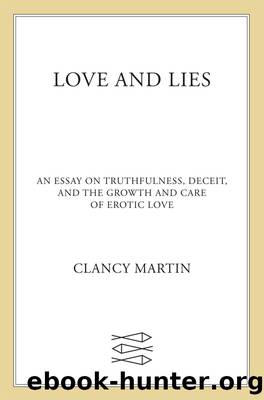
Author:Clancy Martin
Language: eng
Format: epub
ISBN: 9781429945943
Publisher: Farrar, Straus and Giroux
FIRST LIARS
In first love the first lover does not expect the truth from his beloved; he wants to disclose himself to her, but he does not expect her to disclose herself to him. Woldemar sees what an incorrigible liar Zinaida is; Werther does not want Lotte to tell the truth; indeed, he fears that she may do so.
This is not to say that if the first lover were lied to, and the lie had been exposed, he would not feel betrayed. Expecting the truth and expecting not to be lied to are two very different things. Itâs hard to determine how Woldemar feels when he realizes that Zinaida has loved his father all along. He does not appear to be angry with her. He pities her; after all, he knows how she feels.
The first lover hopes, but probably does not expect to get, what he wants; he knows itâs out of reach, and that may well be part of the appeal. This is also precisely why Joyceâs lover in âArabyâ is so angry. He realizes that heâs been lying to himself. âLove itself is a lie!â he seems to conclude, in the brokenhearted state of first love defeated. But that of course is the self-consoling lie that first love tells itself in its attempt to recover from its self-deception.
I know many peopleâincluding my present wife, in the early days of our romanceâwho, because of the feeling of self-betrayal suffered by the first lover, insist for a long time that romantic love is a kind of collective fiction weâve all invented. On this line the open secret is that there is no such thing, really, as love. Itâs sexual desire plus a lie.
They, the first lovers who have been hurt and become skeptics, are right in their way. Erotic love is a kind of tailoring of invisible clothes for the emperor. We will experience only so much as we are willing to believe in what is not âreallyâ there. But love for a child, love for a parent, love for a bookâthe same is true for all our values if we look at them more closelyânone of that is âreallyâ there. We think we live in a world of facts, but all our decisions are based on our values. We canât grab hold of values any more or any less than we can grab hold of love. âSubjectivity is meaningâ: what matters to us is what we ourselves project out into a world that, absent of us, is a collection of indifferent facts.
Perhaps love informs us about truth better than truth informs us about love. Maybe weâve been getting a lot of things backward. Or as Nietzsche thought, we get things right in the way that we actually practice themâwe actually do embrace deception, fantasy, imagination, creativity, illusion, falsehood when we practice the activity of lovingâbut we get things wrong once we start thinking about them, about arranging in our heads how we value them because we are trained from a very early age to suppose that âthe truthâ is something objective and independent of us.
Download
This site does not store any files on its server. We only index and link to content provided by other sites. Please contact the content providers to delete copyright contents if any and email us, we'll remove relevant links or contents immediately.
Twisted Games: A Forbidden Royal Bodyguard Romance by Ana Huang(4034)
The Push by Ashley Audrain(2705)
Den of Vipers by K.A Knight(2704)
Win by Harlan Coben(2667)
Echo by Seven Rue(2248)
Baby Bird by Seven Rue(2224)
Beautiful World, Where Are You: A Novel by Sally Rooney(2181)
A Little Life: A Novel by Hanya Yanagihara(2157)
Iron Widow by Xiran Jay Zhao(2127)
Leave the World Behind by Rumaan Alam(2100)
Midnight Mass by Sierra Simone(2017)
Bridgertons 2.5: The Viscount Who Loved Me [Epilogue] by Julia Quinn(1796)
Undercover Threat by Sharon Dunn(1791)
The Four Winds by Hannah Kristin(1775)
Sister Fidelma 07 - The Monk Who Vanished by Peter Tremayne(1671)
The Warrior's Princess Prize by Carol Townend(1632)
Snowflakes by Ruth Ware(1602)
Dark Deception by Rina Kent(1570)
Facing the Mountain by Daniel James Brown(1556)
